
from US$22.21
Japan, Ogasawara
Stargazing Tour - Observe the best starry sky in Japan, Ogasawara!
Explore
Explore the profound quiet of the universe through NASA's high-resolution archives. Perfect for your stargazing journey.
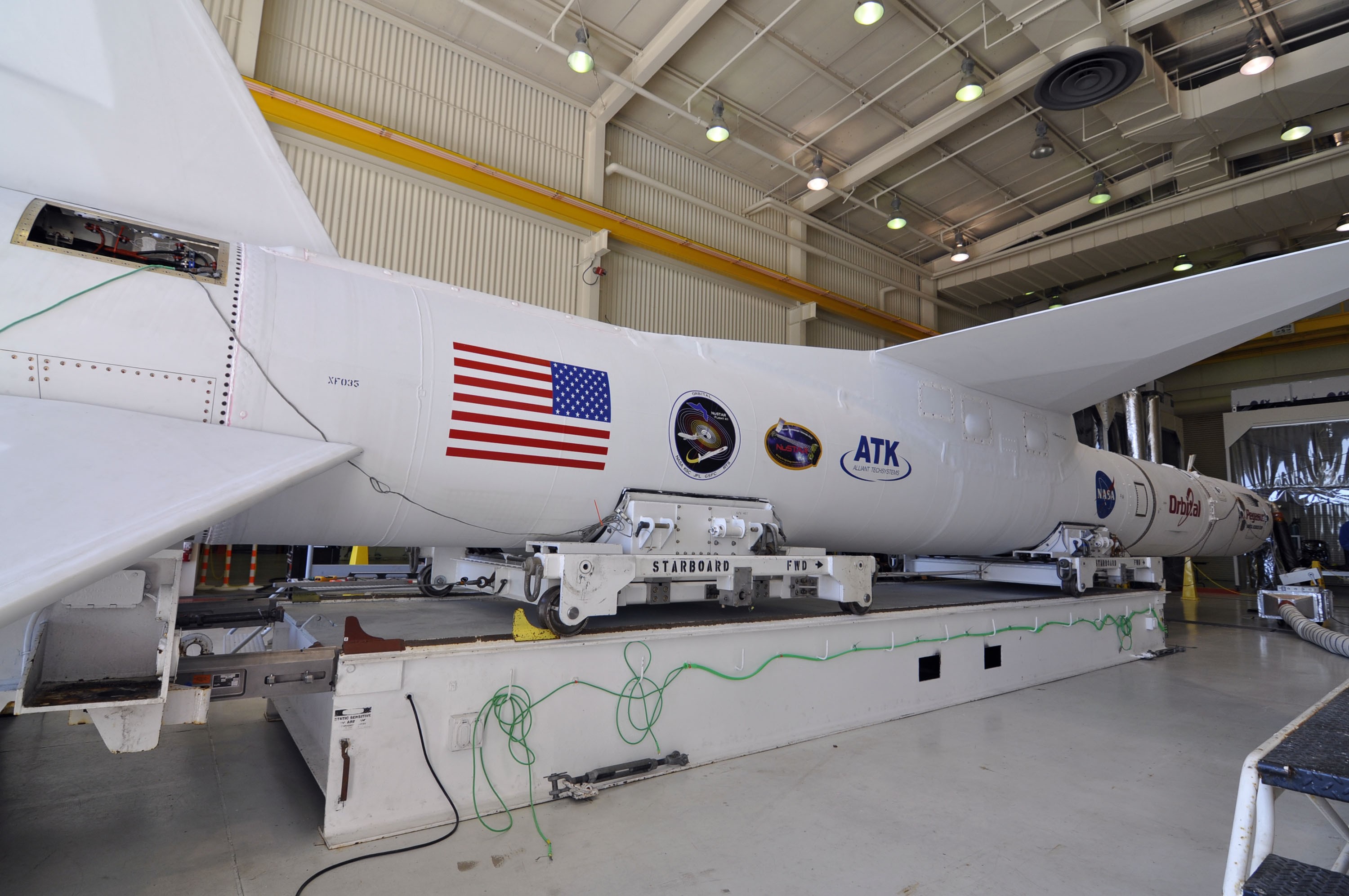
VANDENBERG AIR FORCE BASE, Calif. – An Orbital Sciences Pegasus XL rocket rests on the transporter in Orbital’s hangar at Vandenberg Air Force Base in California. The rocket has been mated to NASA's Nuclear Spectroscopic Telescope Array, or NuSTAR, encapsulated in a Pegasus payload fairing. The transporter will move them to the runway ramp where they will be attached to the underside of Orbital’s L-1011 carrier aircraft. The aircraft will fly the pair from Vandenberg to the Ronald Reagan Ballistic Missile Defense Test Site on the Pacific Ocean’s Kwajalein Atoll for launch. A revised launch date will be set at the Flight Readiness Review, planned for later this week. The high-energy X-ray telescope will conduct a census of black holes, map radioactive material in young supernovae remnants, and study the origins of cosmic rays and the extreme physics around collapsed stars. For more information, visit http://www.nasa.gov/nustar. Photo credit: NASA/Randy Beaudoin, VAFB
This particular celestial object, KSC-2012-1769, was captured by NASA's deep space observatories. While its specific historical mythology remains a mystery, objects of this type are crucial for our understanding of cosmic evolution and stellar life cycles.
To observe phenomena similar to this, we recommend using high-contrast filters and a motorized equatorial mount.
Discover nebula-themed journey sites designed for peaceful observation.
Japan, Ogasawara
Stargazing Tour - Observe the best starry sky in Japan, Ogasawara!
ExploreNew Zealand
Small-Group Refined Experience - Stargazing English Tour in Tekapo | New Zealand
ExploreHawaii
Hawaii Big Island: Mauna Kea Stargazing Half-Day Tour with Transfer Service in Waikoloa, Kona, and Hilo
Explore
NASA often uses 'false color' techniques. Scientists map invisible wavelengths (like infrared) or specific gases to visible colors (red, green, blue) to highlight the nebula's structural details.
While some bright nebulas are visible with entry-level telescopes, capturing these stunning details usually requires deep-sky astrophotography equipment and long exposures.

