
from US$22.21
Japan, Ogasawara
Stargazing Tour - Observe the best starry sky in Japan, Ogasawara!
Explore
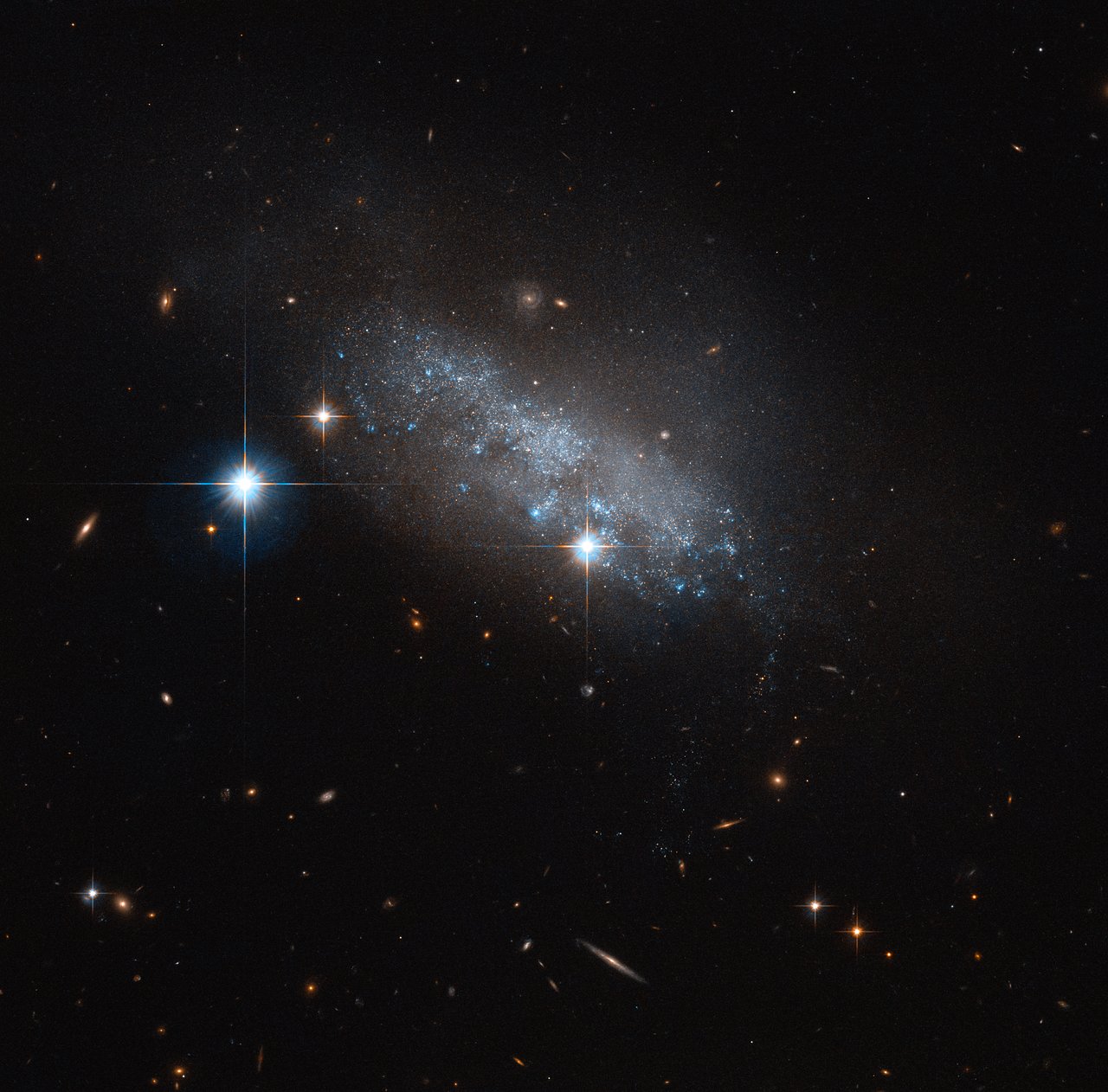
Explore the profound quiet of the universe through NASA's high-resolution archives. Perfect for your stargazing journey.
This delicate blue group of stars — actually an irregular galaxy named IC 3583 — sits some 30 million light-years away in the constellation of Virgo (The Virgin). It may seem to have no discernable structure, but IC 3583 has been found to have a bar of stars running through its center. These structures are common throughout the Universe, and are found within the majority of spiral, many irregular, and some lenticular galaxies. Two of our closest cosmic neighbors, the Large and Small Magellanic Clouds, are barred, indicating that they may have once been barred spiral galaxies that were disrupted or torn apart by the gravitational pull of the Milky Way. Researchers at the University of Leicester, England note there are two types of irregular galaxy. Type I's are usually single galaxies of peculiar appearance. They contain a large fraction of young stars, and show the luminous nebulae that are also visible in spiral galaxies. Type II irregulars include the group known as interacting or disrupting galaxies, in which the strange appearance is due to two or more galaxies colliding, merging or otherwise interacting gravitationally. Something similar might be happening with IC 3583. This small galaxy is thought to be gravitationally interacting with one of its neighbors, the spiral Messier 90. Together, the duo form a pairing known as Arp 76. It’s still unclear whether these flirtations are the cause of IC 3583’s irregular appearance — but whatever the cause, the galaxy makes for a strikingly delicate sight in this NASA/ESA Hubble Space Telescope image, glimmering in the blackness of space. Image Credit: ESA/Hubble & NASA NASA image use policy. NASA Goddard Space Flight Center enables NASA’s mission through four scientific endeavors: Earth Science, Heliophysics, Solar System Exploration, and Astrophysics. Goddard plays a leading role in NASA’s accomplishments by contributing compelling scientific knowledge to advance the Agency’s mission. Follow us on Twitter Like us on Facebook Find us on Instagram
This particular celestial object, Hubble Spotlight on Irregular Galaxy, was captured by NASA's deep space observatories. While its specific historical mythology remains a mystery, objects of this type are crucial for our understanding of cosmic evolution and stellar life cycles.
To observe phenomena similar to this, we recommend using high-contrast filters and a motorized equatorial mount.
Discover nebula-themed journey sites designed for peaceful observation.
Japan, Ogasawara
Stargazing Tour - Observe the best starry sky in Japan, Ogasawara!
ExploreNew Zealand
Small-Group Refined Experience - Stargazing English Tour in Tekapo | New Zealand
ExploreHawaii
Hawaii Big Island: Mauna Kea Stargazing Half-Day Tour with Transfer Service in Waikoloa, Kona, and Hilo
Explore
NASA often uses 'false color' techniques. Scientists map invisible wavelengths (like infrared) or specific gases to visible colors (red, green, blue) to highlight the nebula's structural details.
While some bright nebulas are visible with entry-level telescopes, capturing these stunning details usually requires deep-sky astrophotography equipment and long exposures.

